

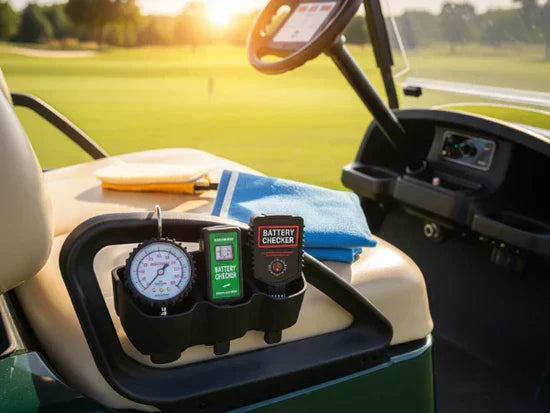
The UAE summer is genuinely hard on vehicles. Temperatures pushing 45–50°C, sand in every gap, humidity swings between coastal and inland areas — a golf cart sitting outside or running daily in these conditions takes a different kind of beating than one used on a temperate Scottish course. Most maintenance advice online is written for milder climates. This is written for here.
1. Battery Care — The Most Expensive Thing to Get Wrong
Heat is the single biggest enemy of battery performance. For lead-acid batteries, high temperatures accelerate water evaporation from the cells — check water levels every two to three weeks during summer, not monthly. Top up with distilled water only, never tap water. For lithium batteries, the chemistry is more stable but heat still degrades cycle life over time, so keeping the cart shaded when not in use makes a real difference across a full season.
Avoid leaving the cart on charge in direct sun. Overcharging a hot battery shortens its life faster than almost anything else. If you're running a lead-acid setup and considering an upgrade, our 48V 105Ah lithium battery with fast charger and BMS is worth looking at — the built-in battery management system handles overcharge protection automatically, which removes one variable from the equation entirely.
2. Tire Pressure — Check It Weekly, Not Monthly
Tire pressure rises with temperature. A tire inflated correctly at 7am can be noticeably over-pressured by midday in July. Overinflated tires reduce the contact patch with the ground, which affects handling and braking distances. Under-inflated tires — more common after a cool night — increase rolling resistance and wear unevenly.
Check pressure weekly, ideally in the morning before the cart has been used. Follow the manufacturer's specification, not a generic figure. If you're running non-standard wheel and tire combinations — say, after a lift kit or an upgrade — the recommended pressure changes too. We carry a range of wheels and tyres suited to UAE conditions, including 14-inch all-terrain sets for carts used on mixed surfaces.
3. Cleaning — More Often Than You Think
Dubai's dust doesn't just sit on surfaces. Fine sand works into joints, electrical connectors, motor vents, and under seat cushions. Left long enough, it becomes abrasive. A cart that runs through sandy terrain — or even sits outside near construction — needs washing more than once a week in peak dust season.
Use a low-pressure hose or a damp cloth around electrical components, sensors, and the battery compartment. High-pressure washing near these areas forces water into places it shouldn't go and can cause corrosion or short circuits. Pay particular attention to the undercarriage if your cart goes off-road — our off-road models are built for rougher use, but they still need the sand cleared out regularly.
4. Brakes and Suspension — Every 3 to 4 Months
Heat affects brake fluid viscosity, and repeated thermal cycling causes components to expand and contract in ways that slowly loosen connections and wear seals. Suspension bushings dry out faster in dry heat, leading to play in the steering that builds gradually enough that you might not notice until it's significant.
Every three to four months is the right interval for a proper brake and suspension inspection in UAE conditions — not the six-month interval often quoted for cooler climates. If you're running a fleet at a resort or facility, this becomes even more important because individual carts may be covering far more distance per day than a privately owned one. Our service and maintenance team handles both one-off inspections and scheduled AMC contracts for fleet operators.
5. Touchscreen and Display Maintenance
Modern electric carts — particularly our on-road models with touchscreen displays — run software that occasionally needs updating. Manufacturers push firmware updates that fix bugs, improve battery management algorithms, and sometimes add features. Skipping these for extended periods can leave known issues unresolved.
Beyond software, the displays themselves benefit from a protective film in UAE conditions. UV exposure at this latitude fades screens and degrades touch sensitivity faster than in temperate climates. Keep the cart shaded when parked, and if your cart supports it, lower screen brightness during peak daylight hours to reduce heat buildup in the display unit.
6. Electrical Connections and Corrosion Checks
This one gets overlooked. The combination of heat, humidity (particularly in coastal areas like Abu Dhabi and Dubai Marina), and fine conductive dust creates conditions where electrical connectors corrode faster than expected. A loose or corroded connection in the main battery circuit causes voltage drop, which the controller interprets as a weak battery — so you get reduced range and sluggish performance without any obvious fault.
Every six months, have a technician inspect and clean the main electrical connectors, particularly around the battery pack, controller, and motor. Dielectric grease on connectors slows corrosion significantly and is cheap insurance against an otherwise puzzling performance problem.
7. Storage and Shade
If your cart sits unused for more than a week — during travel, or between seasonal events — store it in a shaded, ventilated area with the battery at around 50–70% charge, not full and not flat. A fully charged lithium battery stored in heat degrades faster than one at partial charge. Disconnect the main battery if storing for more than a month.
For carts used at outdoor venues, investing in a proper canopy or cart cover pays for itself in reduced UV damage to seats, dashboards, and tyres alone. Our enclosed air-conditioned models sidestep some of these issues entirely — both driver and electronics stay cooler, which extends component life in sustained summer use.
If you're unsure where your cart currently stands — particularly after a hard summer — a full inspection is a reasonable starting point. Get in touch and we'll assess what needs attention. For common questions about maintenance intervals and what's covered under different service arrangements, the FAQs page is a good first stop.

Leave a comment
This site is protected by hCaptcha and the hCaptcha Privacy Policy and Terms of Service apply.